Reader's diary: Midnight's Furies - Nisid Hajari
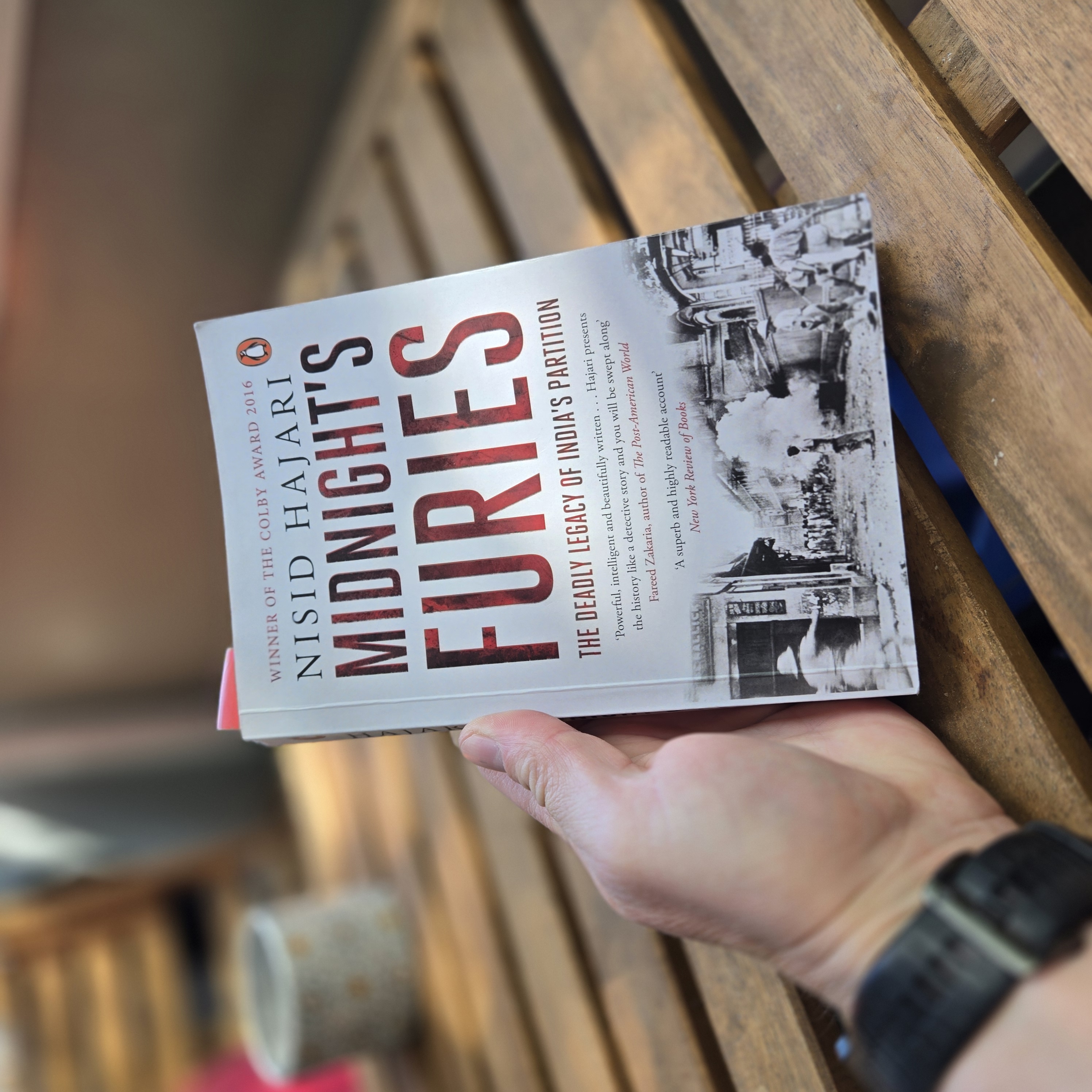
Can a birth of a nation ever be peaceful?
As someone who travels to India rather frequently, and is personally connected to India through family, I have had many conversations about the country’s past and the role of the British or the Muslim minority and the partition itself, usualy people have qute strong opinions on these topics, and one can only go to see the border between India and Pakistan to understand that this is a very alive issue. Hajari’s book offers a deep insight on these subjects and narrates the story of the partition from the beginning, where the idea of Pakistan was basically just a bargaining chip created by Jinnah in order to gain better position for the struggle against his nemesis Nehru, to the point of first communal riots and killings in Kolkata, through the absolutely horrific murdering frenzy along the Punjab borders to the first crises in Kashmir or Hyderabad.
Roots of conflict: Nehru, Jinnah and Mountbatten
Throughout the story is intertwinded the personal rivalry and hostility of the triangle of men: Jinnah, Nehru and Mountbatten, which will define the shape of the subcontinent until today and as a byproduct causes an incredible amount of suffering, tragedy and mistrust for the upcoming generations of the people of the Indian subcontinent.
The book traces the beginning of the hostilities and mutual mistrust between India and Pakistan and its embodiments in the still ongoing conflict in Kashmir, at the roots of the RSS movement that leads to the assassination of Gandhi, radicalisation of Hindus, the motivation of Pakistan to bring the Afghan jihadists to Kashmir and the whole saga of jihadism that follows from there on — many of these issues still fill today’s news headlines.
Hajari writes concisely and accessibly, doesn’t spare either of the sides from their share of responsibility for the mindless terror, reconstructs key events from recordings kept in archives and builds a very plastic tale that should stand as an antidote to anyone trying to simplify the complex story and blame it on one of the sides only. If nothing else was there, this itself would be a great achievement for the book, however the book offers yet another perspective: One can not stop wondering about how different the outcomes might have been if in the leading positions of the communities and parties weren’t these particular ego driven and often vain and unstable men. Perhaps we could have had completely different India, perhaps it should make us think how much power is often entrusted to the hands of (usually) elderly ‘wise’ men. Yes, Donald Trump etc., I am looking at you.
I clearly think this is a very good read for anyone who would like to understand the subcontinent’s history a bit better or would like to have an insight on the ongoing conflict in Kashmir, or a cautionary tale about the lethal power of nationalist or communal frenzy and the misuse of religion and identity.
Warning
However, there is one warning: personally, I find the photographs in the book hard to bear, as they are a very raw witness to the horrors of communal violence between the communities and are just simply shocking in their nature. I have to admit that I was avoiding the pages with them anytime while browsing through the book. Not because of the quality, but because of what is on them.
Perhaps it is good that they are there, as otherwise one could think that this is just an old story that can be forgotten and dismissed. The pictures probably won’t let anyone walk away from the book that easily.
Book: Midnight’s Furies: The Deadly Legacy of India’s Partition